



Choosing a business structure for your company is one of the most crucial first steps to starting a business. Your business entity type has legal, financial, and administrative implications, so it’s important you get started with the best entity for your situation.
Some of the factors that will influence which business entity type you select include:
- Where you plan to conduct your business
- Wanting to have limited personal liability for your business activities
- Whether you will have a partner or an investor
- Your expected earnings and deductions
- Desire to minimize your self-employment tax obligation
- Your business goals
- Your tolerance for compliance formalities
- Registration and administrative costs to set up and maintain a business structure

Comparison Chart of the 7 Most Popular Business Structures
| Sole Proprietorship | General Partnership | Limited Liability Company | C Corp | S Corp | Professional Corporation | Nonprofit Corporation | |
|---|---|---|---|---|---|---|---|
| Formation | None | None | State Filing | State Filing | State Filing | State Filing | State and Federal Filings |
| Limited Personal Liability | No | No | Yes | Yes | Yes | Yes | Yes |
| Transferability of Interest | No | No | Yes (Often Limited) | Yes | Limited | Limited | N/A |
| Duration | Until Withdrawal or Owner Death | Unlimited | Unlimited | Unlimited | Unlimited | Unlimited | Unlimited |
| Pass-through Taxation | Yes | Yes | Yes (Upon Election) | No | Yes | No | Tax Exempt |
| Ability to Raise Capital | Not as a Separate Entity | Yes | Yes | Yes | Yes | Yes | Yes |
| Ownership Limitations | Yes | No | No | No | Yes | No | N/A |
Professional Corporation: Requires owners be within the same profession. Personal liability exceptions exist for cases of malpractice.
Nonprofit Corporation: Capital may be raised via donations or grants.
Digging Deeper into Each Business Entity
To help you gain a basic understanding of the differences between entity types, below is a guide to the most common business structures entrepreneurs choose. Before selecting an entity type, you should talk with your accountant and attorney to determine which will best serve your needs.
Sole Proprietorship
In a Sole Proprietorship, there is no legal separation between the business owner and the business. Property and liabilities are held in the owner’s name. Usually, the owner is an individual, but it could also be a married couple. Business taxes are filed as personal income using Schedule C (Profit or Loss from a Business), which is submitted with IRS Form 1040. Home businesses often select to operate as the Sole Proprietorship structure, because it is the most simple and inexpensive type of entity to establish and maintain.
One drawback to operating a business as a sole proprietor is that usually, the owner is personally liable legally and financially for the business. So, if someone files a lawsuit against the company or the business can’t pay its debts, the owner’s personal assets (bank accounts, home, car, retirement savings, etc.) are at risk.
In most locations, starting a Sole Proprietorship may be as straightforward as filing a fictitious name, also called a DBA (Doing Business As). But even that might not be required if the owner uses his or her first and last name in the business name. Some licensing or permits might be required depending on the type and the location of the business. Otherwise, startup and ongoing compliance formalities are minimal.
When might operating as a Sole Proprietorship be preferable?
- When it’s a home-based business
- When a business has only one owner
- When a business has no employees
- When a business provides products and services that have minimal legal risks associated with them
Also important to note: Another potential downside of the sole proprietorship is that business income is subject to self-employment taxes.
Partnership
In its simplest form, the Partnership structure mirrors a Sole Proprietorship. It is used when there will be more than one owner of the business.
In a General Partnership, owners share legal, financial, and management responsibilities for the business. In fact, the actions of one partner could impose liability on the personal assets of another partner.
Partners, with the help of their attorney, should have a detailed partnership agreement to spell out the division of ownership and duties. As with a Sole Proprietorship, there is no separation between the business and its owners. Business tax obligations pass through to the individual owners.
Other types of partnerships exist, as well, including:
- Limited Liability Partnerships
- Professional Partnerships
- Limited Partnerships
These variations offer more flexibility and liability protection. They also come with more formation and ongoing compliance requirements.
When might operating as a Partnership be preferable?
- When owners don’t intend to reinvest money back into the business
- When a multi-owner business doesn’t want to deal with compliance formalities
- When a multi-owner business has no employees
- When a business provides products and services that have minimal legal risks associated with them
Limited Liability Company (LLC)
The Limited Liability Company structure combines the advantages of a corporation and those of a partnership or Sole Proprietorship. It can be a single-member LLC or a multiple-member LLC. Forming your business as an LLC limits member (owner) liability while requiring less paperwork and fewer formalities than a corporation. To start an LLC, Articles of Organization must be filed in the state(s) in which the business will operate and other tasks must be completed so that the company is following all applicable rules and regulations.
Taxes are handled as they are for a Partnership (or Sole Proprietorship), with all income flowing through to members and reported on their personal tax returns.
An LLC may instead elect to be taxed as a corporation by filing IRS Form 8832 (Entity Classification Election).
The LLC structure also provides management flexibility. It can be member-managed, in which owners handle the day-in-day-out management responsibilities. Or an LLC can designate a person (or persons) as a manager(s), which is called a manager-managed LLC. Most states will by default consider an LLC “member-managed” unless the formation paperwork specifies that it should be “manager-managed” LLC. Learn more about Member-Managed LLC vs Manager-Managed LLC options.
An LLC can benefit from an LLC Operating Agreement, particularly when manager-managed or when it has multiple members, to describe the authority and responsibilities assigned to the individuals involved in the business. Learn more about Single Member LLC vs Multiple Member LLC options.
One disadvantage of the LLC is the inability to issue stock to raise capital. However, many LLCs are able to raise capital by issuing shares of membership, though this may be limited by the language in the LLC’s Operating Agreement.
When might operating as an LLC be preferable?
- When business owners want to limit personal liability but don’t want the compliance formalities of a Corporation
- When business owners want flexibility in who owns and manages their company
- When a business doesn’t plan to seek venture capital and equity funding
C Corporation
C Corporation is a confusing phrase to a lot of people. The IRS uses this term “C-Corp” for the purpose of distinguishing a for-profit Corporation from one that has elected to be taxed as an S Corporation.
The Corporation is a legal entity separate from its owners, and it provides a significant degree of personal liability protection for its owners (shareholders). Ownership is through holding stock in the company, which may be held privately or publicly. The ability to sell stock in the business offers an opportunity to raise capital to fund initiatives and fuel growth. Status as a Corporation often makes a business more attractive to outside investors, as well.
A Corporation must file its own income tax return (IRS Form 1120). The company receives deductions for business expenses, which reduces its tax liability when it earns revenue. It may not be deducted as an expense money paid to stockholders as dividends, and the individual stockholders who receive dividends must pay income tax on that income. The term “double taxation” is often used to describe how the profit of a corporation is taxed, and then profits distributed as dividends (which are not deductible as expenses to the business) are taxed to shareholders.
Incorporating a business involves filing Articles of Incorporation with the state, and it comes with higher startup costs and more administrative complexity than running a business as a Sole Proprietorship, Partnership, or LLC. A Corporation must have bylaws, a board of directors, hold meetings on a regular basis, and abide by other regulations to maintain its status.
When might operating as a C Corporation be preferable?
- When a company’s profits are expected soon and will be reinvested
- When a company wants to seek venture capital and equity financing
- When a company wants to have a large number of shareholders
S Corporation
The S Corporation is a subtype of the corporation structure. It allows a C Corporation to elect to be taxed as a Partnership, with all business income taxed at the owner (shareholder) level at the tax rate for individuals. This avoids the double taxation that Corporations normally face (i.e., some income taxed at the corporate rate and then again taxed at the individual rate when distributed to shareholders). One potential tax advantage for owners is that instead of all their business income being subject to self-employment tax, only owners’ salaries are. Any profit is given to shareholders as distributions are not.
Some other advantages of a C Corporation, such as personal liability protection, are retained. On the other hand, a number of restrictions on ownership of stock apply in an S Corporation. For example, it may only issue one class of stock, it may only have up to 100 stockholders, and it cannot have shareholders who are nonresident aliens.
Today, the IRS allows multiple types of entities to elect to be taxed as an S Corporation. For example, an LLC, just like a Corporation, could elect to be taxed as an S Corp if files for S Corporation Election by the required deadline.
When might operating as an S Corporation be preferable?
- When an LLC’s members want to minimize their self-employment tax burden
- When a Corporation wants to avoid double taxation on dividend income
- When a company doesn’t have a need for issuing more than one class of stock or having more than 100 shareholders
Nonprofit Corporation
A Nonprofit Corporation is created to fulfill a civic, religious, educational, or charitable goal. Nonprofits are tax exempt, and as such do not pay income tax. They may also be eligible to accept donations.
Forming a Nonprofit can be a complicated and lengthy process. It begins with filing Articles of Incorporation with the appropriate state agency. Then, to obtain tax-exempt status, a Nonprofit must apply with the IRS (Form 1023) and also within the state(s) in which it will operate. What is considered an acceptable business purpose for qualifying for tax exemption may vary significantly from state to state.
A Nonprofit must adhere to some strict reporting and compliance requirements at the state and federal level, or it could put its tax-exempt status in jeopardy.
Some potential disadvantages of the nonprofit structure are the restrictions in activities it may legally conduct and that it cannot be sold. At the time when a Nonprofit Corporation becomes dissolved, its assets must get transferred to another nonprofit organization.
When might operating as a Nonprofit be preferable?
- When the purpose of the business is for a cause, not for generating profit for its owners
- When the organization is a charity, religious group, educational organization, etc.
Professional Corporation (PC)
Some states require that business owners in certain professions form their companies as a Professional Corporation (also known as a “Professional Service Corporation”). This is a limited liability type of corporation in which all owners (shareholders) hold a professional license.
Note that a Professional Corporation does not shield the professional who commits malpractice from personal liability. Therefore, a one-person PC offers no personal liability protection to its sole shareholder. In a multi-member PC, however, the personal assets of the other shareholders may be protected while the professional who committed the act which caused the liability to the PC may be held personally liable. By obtaining professional liability insurance, individual shareholders can help protect themselves.
In states where this structure exists, the Secretary of State office (or similar agency) will maintain a list of the occupations it applies to—typically doctors, veterinarians, lawyers, accountants, and other professions that run higher liability risks.
A professional corporation must usually identify a single purpose—to practice a specific profession—as explained in its Articles of Incorporation.
A separate entity from its owners, a professional corporation is considered a C Corp for tax purposes unless it elects for treatment as an S Corporation.
When might operating as a Professional Corporation be preferable?
- When it is required by the state in which the business will be operated
- When a business has multiple owners who are professionals providing services that are a high liability risk
Need Assistance?
You can use CorpNet’s Business Structure Wizard for additional insight into which business entity type might make the most sense for your company. But nothing is a substitute for the important legal and tax guidance of an attorney and an accountant. There’s far too much at stake, so make sure you’re aware of all the pros and cons of each option.
And after you’re ready to move forward with starting your business, contact CorpNet to help you with all your business registration filings! We can save you time and money when preparing and submitting your paperwork.
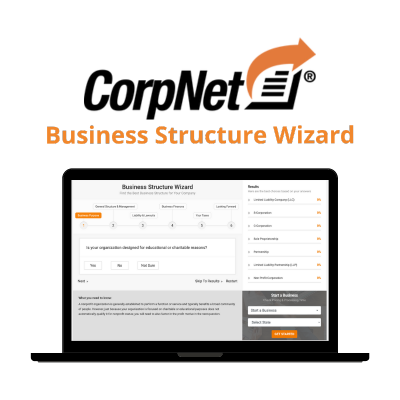
Choosing a business structure can be a tough decision for the new business owner. CorpNet wants to make the process easier.
This free, online tool helps small business owners navigate the process of picking the right business structure for their new business.
