


Incorporating a business provides many benefits for companies of all types and sizes. The process requires filing paperwork and paying a fee to have the state recognize the business as an official entity.
Before deciding on a specific type of Corporation, you should think through several considerations that include:
- Where business will be conducted
- Wanting to have limited personal liability for business activities
- Whether the business will have a partner or an investor
- The company’s expected earnings and deductions
- Desire to minimize self-employment tax obligation
- Business goals
- Tolerance for compliance formalities
- Registration and administrative costs to set up and maintain a business structure
Comparison Chart of Incorporation Options
Once you’ve decided that incorporating is right for your business, the next step is to consider the various types of Corporations available. There are generally four types of entities commonly used for incorporation. These include C Corporations, S Corporations, Nonprofit Corporations, and Professional Corporations. Below is a high-level summary of the key elements of each option.
| C Corporation | S Corporation | Professional Corporation | Nonprofit Corporation | |
|---|---|---|---|---|
| Formation Filing | State | State | State | State & Federal |
| Limited Personal Liability | Yes | Yes | Yes | Yes |
| Transferability of Interest | Yes | Limited | Limited | n/a |
| Duration | Unlimited | Unlimited | Unlimited | Unlimited |
| Pass-through Taxation | No | Yes | No | Tax Exempt |
| Ability to Raise Capital | Yes | Yes | Yes | Yes |
| Ownership Limitations | No | Yes | No | n/a |
Now that we’ve reviewed a high level summary, let’s review more specifics for each business entity option.
C Corporation
- A C Corporation is also known as a general for-profit Corporation.
- It is the most common form of corporate entity.
- The C Corporation is formed by filing Articles of Incorporation with the state.
- This business type is owned by shareholders.
- There are no limits on the number of owners.
- The shareholders elect a Board of Directors, which creates and directs the high-level policies of the business. The Board of Directors then appoints corporate officers, who in turn manage the day-to-day operations of the business.
- Shareholders generally have limited liability, even when involved in day-to-day management while serving as an employee or a corporate officer.
- The shares of a C Corporation are freely transferable unless limited and documented by the shareholders.
- The C Corporation exists indefinitely, unless and until it is dissolved.
- It is a separately taxable entity, meaning it must file a tax return for the business and pay corporate taxes on its profits.
S Corporation
- The S Corporation is election to be taxed as a pass-through entity under Subchapter S of the Internal Revenue Code.
- An S Corporation is not taxed separately and apart from its owners/ shareholders. Instead, corporate profits and losses are passed through and reported on the personal income tax returns of the shareholders, much like a Sole Proprietorship or Partnership.
- An S Corporation has limitations on ownership:
- The number of shareholders is limited to 100.
- Each shareholder must be an individual or a trust. A shareholder cannot be another Corporation.
- Each shareholder must be a citizen of the United States; a resident alien, which is a foreign born, non-U.S. citizen legally residing in the United States; or meet certain other tax-related regulations.
- A S Corporation can nly one class of stock.
- Owners who do substantial work for a Subchapter S Corporation are considered employees, which brings greater payroll responsibilities.
Nonprofit Corporation
- A Nonprofit Corporation is a business incorporated under state laws to operate for purposes other than generating a profit. The business must be formed for charitable, educational, religious, literary, or scientific purposes
- A Nonprofit Corporation is not formed for the purpose of generating profits for its shareholders.
- A Nonprofit Corporation may be formed under Section 501(c)(3) of the Internal Revenue Code. A fully and properly qualified 501(c)3 Nonprofit Corporation has the following characteristics:
- The business is exempt from taxation.
- A tax-exempt Corporation is prohibited from paying dividends to shareholders.
- If the business is dissolved, its assets generally must be distributed to another qualified nonprofit group.
- Significant filing requirements may exist at both the state and federal levels to establish and maintain tax-exempt status.
- A Nonprofit Corporation may be prohibited from engaging in certain activities, including participating in political campaigns and substantial engagement in lobbying activities.
- Nonprofits can own assets and generate income (usually in the form of donations or grants) and they can take out loans, but there is no ownership to sell in the sense of investments.
- Dissolving a nonprofit is complicated. Nonprofits cannot be sold in the traditional sense. All assets must be transferred to another nonprofit or put toward the purpose of the organization. No funds can be directly distributed to the owners.
Professional Corporation
- A Professional Corporation is used by licensed professionals such as doctors, attorneys, accounting professionals, architects, engineers, veterinarians, and other licensed professionals.
- Most states have special filing requirements when incorporating.
- A Professional Corporation shields a professional service provider from liability for the operations of the business or a business partner.
- A Professional Corporation does not protect a professional from being liable for their own malpractice. Someone who has committed malpractice can be sued by a patient or client, putting their personal assets at risk.
- The tax advantages for a Professional Corporation are the same as the advantages afforded to a C Corporation or S Corporation.
- Corporate filing requirements can vary and may be more or less expansive depending on the state.
- Laws governing professional services and Corporations are often quite complex. I strongly urge you to consult an attorney before deciding to incorporate as a Professional Corporation.
What’s Next?
Once you’ve explored different avenues regarding the type of Corporation that’s best for your business and obtained any legal or financial advice you need, contact CorpNet. Our experienced, dedicated team can help you with all your business registration filing needs in a timely and cost-effective manner.
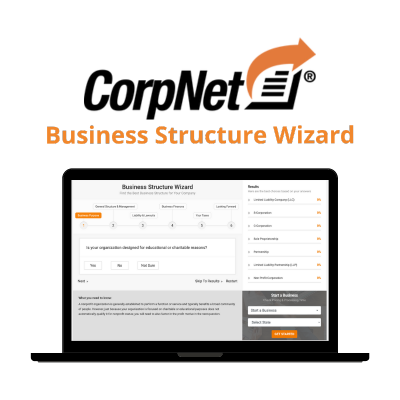
Choosing a business structure can be a tough decision for the new business owner. CorpNet wants to make the process easier.
This free, online tool helps small business owners navigate the process of picking the right business structure for their new business.