



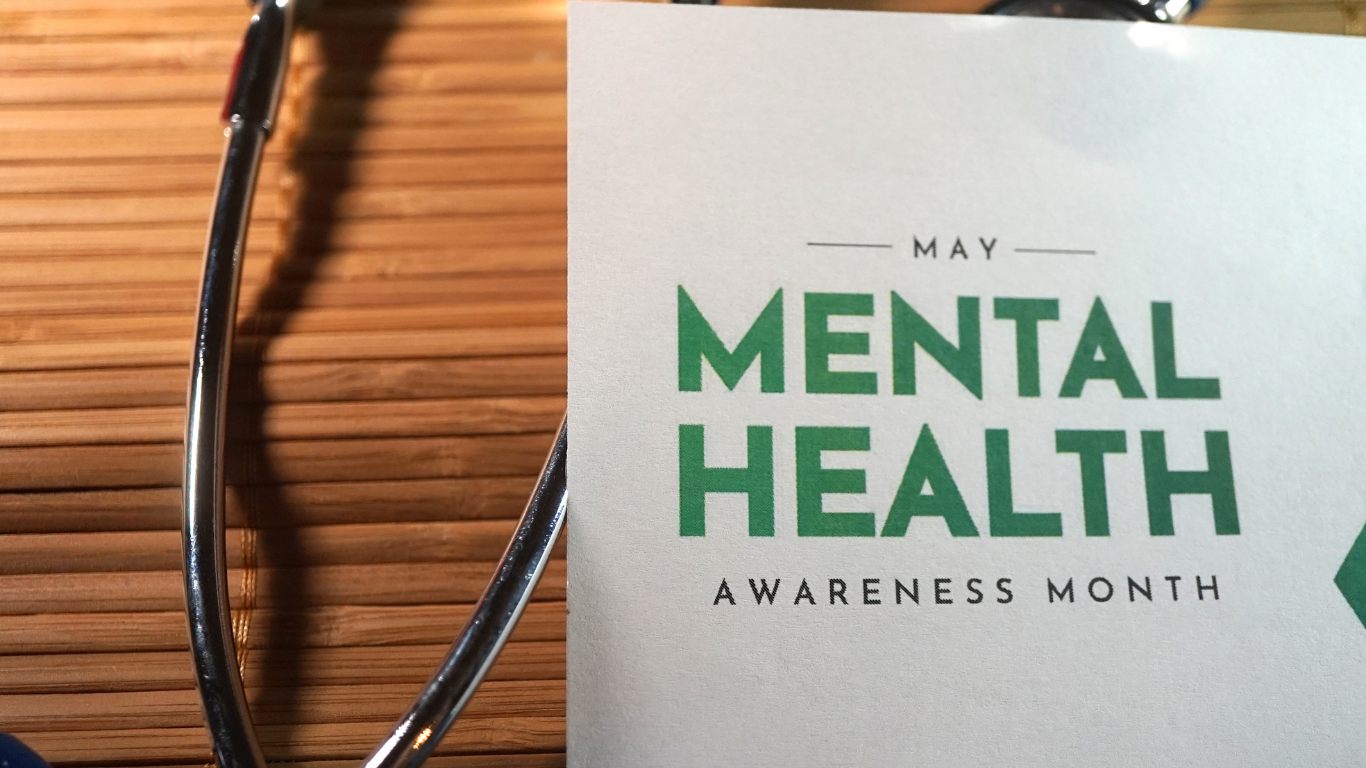
May is a meaningful month for me. It’s National Small Business Month, when we celebrate the millions of entrepreneurs whose work powers our communities and our economy. It’s also Mental Health Awareness Month, a time when we acknowledge that taking care of our minds is just as essential as taking care of our businesses. That these two observances share a calendar feels right to me — because nearly thirty years of building and leading businesses has taught me that you cannot pour from an empty cup. Your business is only as healthy as the person leading it.
My Own Story
I’m a founder. I’m a CEO. I’m a wife. I’m a mom of four. I’m a daughter. I’m a friend. I’m a boss. I’m a human being.
On any given day, every one of those identities is pulling from the same finite reservoir of energy. And there have been seasons in my life when the weight of it has caught up with me in ways I never saw coming.
A number of years ago, sitting in my car at an intersection just outside our office — a spot I’d driven through hundreds of times without thinking — my body went into full-blown panic. Heart pounding. Lungs locked. The inside of the car shrinking around me. For a few minutes I genuinely believed something terrible was about to happen. I wrote about that moment for HuffPost not long after, because the more I sat with it, the more I understood that the panic attack hadn’t come out of nowhere. It was my body finally refusing to keep absorbing what I’d been carrying.
I started working with a therapist after that. I still do. Over the years, I’ve built a small set of practices that keep me steady through the highs and lows of running a company. I practice yoga and meditation regularly, take reformer Pilates classes for low-impact strength, and make space for a facial or massage when I can. I lean on my faith, on my husband and business partner Phil, on our four children, on warm baths, quiet mornings, and time genuinely away from my phone.
More recently, menopause has added an entirely new dimension to leading a business as a woman in midlife. There have been long afternoons when I’ve sat through meetings fighting to stay focused, only to find myself working late into the night to catch up on what brain fog had stolen from my day. I share that because nobody talked to me about it before I lived it, and I think more of us need to talk about it now.
What I’ve learned through all of it is that vulnerability isn’t a weakness in a leader. It’s the doorway to the kind of resilience that sustains a business — and a life — over the long haul.
The Scale of What We’re Carrying
If you’ve felt overwhelmed running your business, please hear me: you are not alone, and the data backs you up.
A 2023 study by Small Biz Silver Lining, reported in Inc. magazine, found that 75% of small business owners are concerned about their mental health — and 56% have actually been diagnosed with anxiety, depression, or a stress-related condition by a doctor or mental health professional. Earlier UCSF and UC Berkeley research found that roughly 72% of entrepreneurs reported mental health concerns, a notably higher incidence than in the general population.
The financial pressures alone are extraordinary. Bluevine’s 2026 small business survey found that 62% of owners had reduced or skipped their own pay at least once in the past year to cover business expenses, and 68% had delayed or avoided a major business decision because of financial stress. The top source of anxiety wasn’t taxes or debt — it was timing: getting money in the door fast enough to keep the lights on.
These aren’t just statistics. They are our peers. Our friends. Many of you reading this.
Why Entrepreneurs Are Uniquely Vulnerable
There’s a reason founders carry so much. When you start a business, you don’t just take on a job. You take on a financial risk, a public identity, a team’s livelihoods, a family’s stability, and a future you’ve staked everything on. The boundary between you and your business is, by definition, blurry.
A handful of forces tend to compound the pressure:
- Identity fusion. When your name is on the door, every business challenge can feel like a personal verdict on your worth.
- Loneliness at the top. Founders rarely have a safe place to talk through fear, because the people around them often depend on them appearing steady.
- Always-on technology. Email, text messages, DMs, Slack, and AI agents have made “off hours” largely theoretical.
- Compliance overload. State filings, HR compliance, federal deadlines, tax filings, payroll, sales taxes, and annual reports can fill a brain that’s already full.
- Sleep deprivation. Many of us, especially parents, are running on chronic sleep debt that quietly erodes judgment and mood.
Recognizing these forces doesn’t make them disappear. But it helps reframe the experience: you’re not failing. You’re a human being under an unusual amount of strain.
Recognizing the Signs of Burnout
Burnout rarely arrives like a thunderclap. For most of us it builds slowly, then suddenly. Mental health professionals describe it as emotional exhaustion, a sense of cynicism or detachment from work, and a feeling of reduced accomplishment — even when, objectively, you’re achieving a great deal.
Some quieter signals I’ve personally come to take seriously:
- Persistent fatigue that sleep doesn’t seem to fix
- Loss of interest in parts of the business I used to love
- Snapping at people I care about over small things
- A creeping sense of being “behind” no matter how much I do
- Trouble making decisions I’d normally make in five minutes
- Physical changes — headaches, stomach issues, tight shoulders, disrupted sleep, or appetite shifts
If you notice several of these in yourself, please take it seriously. These signals are worth talking through with a qualified mental health professional. They are not a character flaw. These are signals that you may be overworking yourself.
What’s Helped Me (and the Founders I Know) with Mental Health
I am not a therapist, a psychiatrist, or a medical professional, and nothing in this article is a substitute for working with one. But, I can offer the practices I and the founders in my circle have found helpful. Your version of this list may look entirely different — and that’s perfectly okay.
- Working with a licensed therapist. This is the most important item on the list (for me, personally). A good therapist gives you a confidential space to process what you’re carrying — something most founders desperately need.
- Regular check-ins with your doctor. Stress, hormones, sleep, and thyroid function all influence mood. A physician can help untangle what’s physical and what’s emotional.
- Movement you actually enjoy. For me it’s typically yoga or Pilates. For you it may be hiking, lifting, swimming, or dancing. The point is consistent movement that lifts your spirit, not a punishment regimen.
- Sleep!!! One of the most under-prescribed interventions for entrepreneurs. Your body needs rest and recovery time.
- Peer communities of other founders. Organizations like EO, YPO, Vistage, and SCORE exist specifically because founders need other founders to talk to.
- Time genuinely off. Not a “working vacation.” Real days where the laptop stays closed.
- Saying no. Every yes is a no to something else — usually your family or your rest.
For me, faith and family sit at the center of how I keep my head above water. Your anchor may look different. The point is to have one.
Building a Real Support System
One of the most freeing realizations I’ve had as a leader is this: I don’t have to be the expert on everything. It’s important to delegate to others and to professionals when I can. Trying to play a million roles for my own business is exactly how I and founders alike end up burned out.
A healthier model is to assemble a real bench:
- A CPA or accountant for tax planning, payroll, and financial decisions
- A business attorney for contracts, IP, employment matters, and legal questions
- A financial advisor for personal and business wealth planning
- A licensed mental health professional for the part of you that runs all of it – this one is important and most commonly overlooked.
- A community of peers who understand the founder experience from the inside, so that you have someone to relate with.
I know this list can feel expensive when cash is tight. The cost of going without proper support is almost always higher — in dollars and in years of your life.
Mental Health Resources for Small Business Owners
If you or someone you love is struggling, please reach out. Help is available — much of it free, confidential, and accessible around the clock.
- 988 Suicide & Crisis Lifeline — call or text 988 any time for free, confidential support. Chat at 988lifeline.org.
- NAMI HelpLine — 1-800-950-NAMI (6264) or text “HelpLine” to 62640, Monday–Friday, 10 a.m.–10 p.m. ET. More at nami.org.
- SAMHSA’s National Helpline — 1-800-662-HELP (4357), a free, confidential, 24/7 service. More at samhsa.gov.
- Mental Health America — free, anonymous screenings at mhanational.org.
- SCORE — free mentorship and peer support communities at score.org.
If you are in immediate danger, please call 911 or go to your nearest emergency room.
Where CorpNet Fits Into This Picture
I want to be transparent about the role we want to play in your life as a business owner. CorpNet is a document filing service — not a law firm, not a tax firm, and not a financial planner. What we do is take the administrative weight of compliance off your shoulders: annual reports, registered agent representation, BOI reporting, foreign qualifications, payroll tax registrations, and the rest of the state-level paperwork that keeps a business in good standing.
Every hour you spend hunting down a state form is an hour you don’t have for your family, your team, your rest, or yourself. When business owners tell me that working with us “took something off my plate I didn’t realize was making me anxious,” that’s the part I’m most proud of.
A Final Word
If you’re reading this and you’ve been quietly struggling, hear me clearly: what you’re feeling is real, you are not alone, and asking for help is one of the strongest things you can do as a leader.
May is a beautiful month to start. Take one small step this week. Schedule the therapy appointment. Text 988 if you need to. Call your doctor. Tell your spouse the truth. Join a peer group. Block off a Saturday with nothing on it.
Your business needs a healthy you. Your family needs a healthy you. And the world needs you here, long enough to build the company you set out to build.
More from Nellie on Mental Health and Entrepreneurship
Frequently Asked Questions
Is burnout common among small business owners?
Yes. A 2023 Small Biz Silver Lining study reported by Inc. found that 75% of small business owners are concerned about their mental health, and 56% have been diagnosed with anxiety, depression, or a stress-related condition. UCSF and UC Berkeley research has also reported that entrepreneurs experience mental health concerns at a notably higher rate than the general population.
What are early signs of burnout in entrepreneurs?
Common early signs include persistent fatigue, sleep changes, appetite changes, irritability, loss of interest in work, difficulty making routine decisions, social withdrawal, and physical symptoms such as headaches or stomach issues. These signals are worth discussing with a qualified mental health professional rather than self-diagnosing.
Where can a small business owner get free or low-cost mental health support?
Free, confidential resources include the 988 Suicide & Crisis Lifeline (call or text 988), the NAMI HelpLine (1-800-950-6264), and SAMHSA’s National Helpline (1-800-662-4357). Many therapists also offer sliding-scale fees, and Mental Health America provides free screenings at mhanational.org.
Why is May significant for small business mental health?
May is both National Small Business Month and Mental Health Awareness Month in the United States, making it a natural moment to address the intersection of entrepreneurship and well-being.